
Utah homeowners are increasingly asking one important financial question in 2026:
“If I turn my basement into a legal apartment… how much money can it actually make?”
With housing prices across Salt Lake County and Utah County continuing to climb, more homeowners are turning their unfinished basements into income-producing rental apartments.
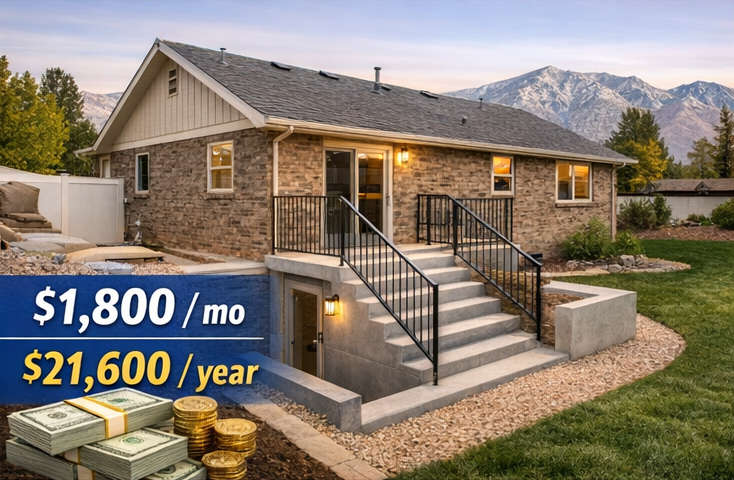
Instead of sitting unused, your basement can potentially generate $18,000–$26,000 per year in rental income. But does the math actually make sense?
The 2026 Utah Basement Apartment Income Reality
Basement apartments have quietly become one of the most powerful wealth-building tools for Utah homeowners. In real estate circles, this strategy is often called “house hacking” — using part of your own home to generate income that offsets your mortgage.
Across fast-growing cities like Draper, Lehi, and Sandy, the demand for affordable rental housing has surged as home prices have climbed. This demand has driven a major increase in Internal Accessory Dwelling Units (I-ADUs) — legal basement apartments built within existing homes.
Utah’s housing shortage has created a unique situation where basement rentals are not just common — they’re often essential. Many tenants prefer basement apartments because they offer significantly lower rent than full apartments while still providing privacy, a kitchen, and a separate entrance.
Average Basement Rental Income in Utah
Rental prices vary depending on square footage, location, parking availability, and whether the unit has a private entrance. However, the following ranges represent typical market rates across the Wasatch Front in 2026.
- Lehi: $1,700 – $2,100 per month
- Draper: $1,800 – $2,200 per month
- Sandy: $1,600 – $2,000 per month
- Herriman: $1,600 – $2,100 per month
At these rental levels, the average basement apartment can produce $20,000+ per year in rental income. For many homeowners, that income covers a large portion of their monthly mortgage payment, property taxes, or renovation costs.
This is why so many homeowners completing projects in Utah County and Salt Lake County choose to design their basement renovation as a legal rental unit rather than a simple guest suite.
Utah Housing Trend: According to local real estate data, homes with legal basement apartments often attract more buyers because the rental income can help offset mortgage payments. In competitive housing markets, this can significantly increase a home’s appeal.
For homeowners willing to navigate the permits, building codes, and design considerations required for an I-ADU, the financial upside can be substantial — especially when rental income is combined with rising property values over time.
How Much Does It Cost to Build a Legal Basement Apartment?
The cost of converting a basement into a legal rental apartment varies depending on several structural and code-related factors. Unlike a simple basement finishing project, a legal apartment must meet stricter safety and building standards designed to protect both the homeowner and tenant.
Contractors must account for layout changes, kitchen installation, plumbing lines, fire separation between units, HVAC zoning, and whether a dedicated exterior entrance needs to be constructed. These requirements ensure the space qualifies as a legal Internal Accessory Dwelling Unit (I-ADU) under Utah law.
Across Salt Lake County and Utah County, most homeowners find their project falls within the following ranges:
| Project Type | Estimated Cost |
|---|---|
| Basic Basement Finish | $55,000 – $75,000 |
| Legal Basement Apartment (I-ADU) | $85,000 – $120,000+ |
The difference between a standard basement remodel and a legal rental unit often comes down to the systems installed behind the walls. Rental units must meet strict building codes for safety, privacy, and livability.
These requirements add additional construction steps that a simple guest suite or recreational basement typically doesn’t require.
The additional cost primarily comes from:
- Full kitchen installation including cabinetry, appliances, plumbing, and electrical connections
- Fire-rated drywall separation between the basement and main living space
- Separate entrance construction such as a walkout stairwell or exterior door
- Additional plumbing and electrical circuits required for independent living space
- HVAC zoning or mini-split systems to control temperature independently
- Soundproofing improvements to reduce noise transfer between floors
Pro-Worx Tip: Many homeowners choose to “future-proof” their basement by rough-installing plumbing and electrical for a kitchen during the initial remodel. Even if you don’t install the stove immediately, the infrastructure will already be in place if you decide to convert the space into a rental later.
Legal Requirements for Basement Apartments in Utah
Before turning a basement into a rental unit, homeowners must understand the legal requirements that govern basement apartments in Utah. These rules exist to protect tenants and ensure rental units meet basic safety and livability standards.
Most Utah cities classify basement apartments as Internal Accessory Dwelling Units (I-ADUs). State legislation passed in recent years has made it easier for homeowners to build these units, but each city still enforces its own permitting requirements.
Common Requirements for Legal Basement Apartments
- Separate Entrance: Most cities require a dedicated entrance for tenants.
- Full Kitchen: A legal rental unit must include a stove, sink, and refrigeration.
- Fire Separation: Fire-rated drywall is often required between floors.
- Egress Windows: Bedrooms must have emergency escape windows.
- Parking Requirements: Some cities require an additional off-street parking space.
Cities such as Lehi, Draper, and Sandy have updated zoning codes in recent years to allow more homeowners to create rental units legally.
While it may be tempting to skip permits, unpermitted basement rentals can create serious problems later. Cities may issue fines, insurance claims may be denied, and homeowners may even be required to remove the kitchen or shut down the rental unit entirely.
Important: A legal basement apartment protects both the homeowner and tenant. Permits ensure the unit meets fire safety, ventilation, and structural standards that prevent dangerous living conditions.
Working with a contractor familiar with Utah’s I-ADU requirements helps homeowners navigate permits, inspections, and building codes without costly mistakes or delays.
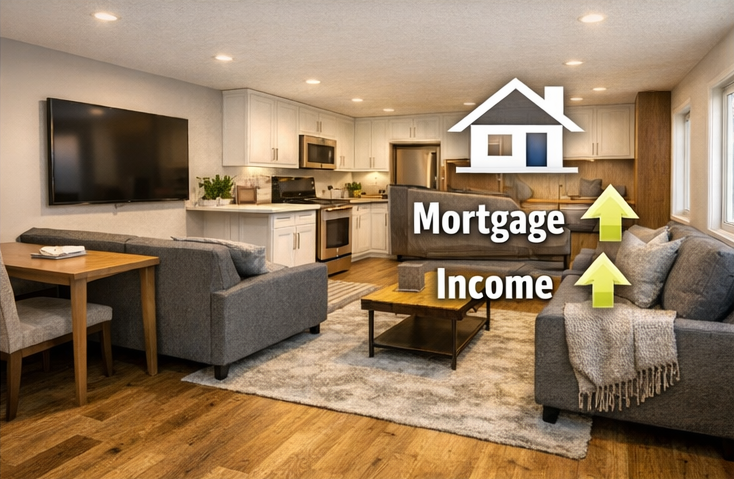
The Payback Timeline: When Does It Become Profitable?
The most important number homeowners care about when considering a basement apartment is the payback period. In simple terms, this is the amount of time it takes for rental income to recover the cost of construction.
Because rental demand is strong across the Wasatch Front, many Utah homeowners find that a legal basement apartment begins paying for itself faster than most other home renovations. Unlike kitchens or bathrooms—which primarily increase resale value—rental units generate monthly cash flow.
In areas like Lehi, Draper, and Sandy, rental income from a basement apartment can often cover a large portion of a homeowner’s mortgage payment.
| Scenario Example | Amount |
|---|---|
| Construction Cost | $95,000 |
| Monthly Rent | $1,500 – $1,600 (Utah Market) |
| Annual Income | $19,200 |
| Payback Period | 4 – 5 Years |
Once the construction cost has been recovered, the rental income effectively becomes additional monthly cash flow for the homeowner. At that point, the basement apartment functions less like a renovation and more like a long-term income stream.
Why Basement Apartments Pay Off Faster Than Most Renovations
Many home upgrades improve resale value but do not produce direct income. A kitchen remodel or bathroom renovation might increase a home’s selling price, but the financial return typically only appears when the home is eventually sold.
A basement apartment is different because it produces immediate financial return. Instead of waiting years to recover renovation costs through resale value, homeowners begin seeing financial benefits as soon as the unit is rented.
The Long-Term Wealth Impact
Rental income compounds quickly over time. A basement apartment generating $1,900 per month can produce:
- 5 Years: $114,000 in rental income
- 10 Years: $228,000 in rental income
- 20 Years: $456,000 in rental income
During the same period, the property itself continues to appreciate in value. Homes with legal basement apartments often sell for more because buyers recognize the income potential and the ability to offset their own mortgage payments.
Pro-Worx Insight: A legal basement apartment doesn’t just increase square footage — it transforms your home into an income-producing asset that can help pay your mortgage every month.
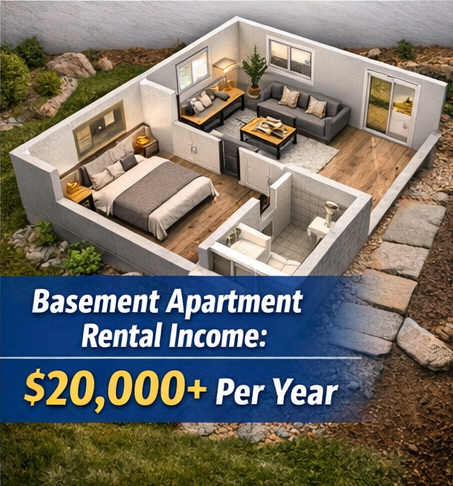
Basement Apartment Layout Ideas That Maximize Rental Income
Not all basement apartments generate the same rental income. Layout design plays a major role in how attractive the unit is to potential tenants and how much rent it can command.
In cities like Lehi, Draper, and Sandy, renters expect a basement apartment to feel like a fully independent living space—not just a converted storage area.
A well-designed layout improves both tenant experience and rental value. Small design decisions—such as natural light placement, kitchen layout, and private entry access—can increase monthly rent by several hundred dollars.
High-Value Layout Features for Basement Rentals
- Open Living Room + Kitchen Layout – Open floor plans make basement units feel larger and brighter.
- Private Bedroom Placement – Bedrooms positioned away from shared staircases increase privacy.
- Large Egress Windows – Natural light dramatically improves tenant appeal.
- Separate Laundry Area – Dedicated laundry access is a major tenant preference.
- Private Storage Space – Lockable storage adds convenience for long-term renters.
Many homeowners also design basement apartments with two bedrooms instead of one. While this increases construction costs slightly, it often increases rental income significantly by making the unit attractive to roommates or small families.
Pro-Worx Design Tip: One of the most valuable upgrades in a basement apartment is improving natural light. Enlarged egress windows or walk-out basement entrances can dramatically change how spacious and comfortable the unit feels.
The goal when designing a basement rental is simple: create a space that feels like a complete home rather than an extension of the main house. When done correctly, tenants often stay longer, which reduces turnover and increases long-term profitability.
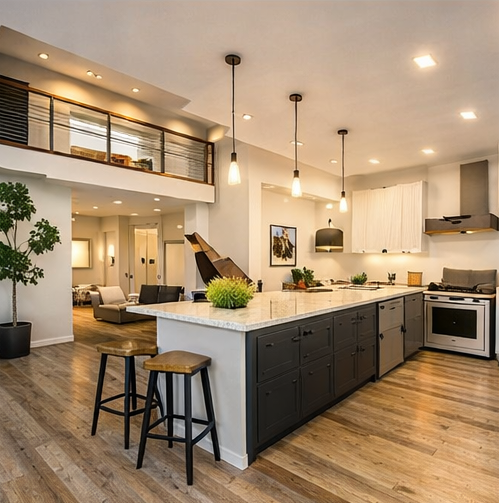
Basement Apartment vs Guest Suite: Which One Makes More Money?
Many Utah homeowners start their basement remodel thinking about a guest suite, home theater, or recreational space. These upgrades certainly improve comfort and resale value—but they don’t generate direct income.
A legal basement apartment changes the financial equation completely. Instead of simply adding usable square footage, the space becomes an income-producing asset that can help offset mortgage payments and household expenses.
| Feature | Guest Suite | Legal Basement Apartment |
|---|---|---|
| Estimated Cost | $55k – $75k | $85k – $120k+ |
| Rental Income | $0 | $1,500 – $2,200/month |
| Annual Income | None | $19,000 – $26,000+ |
| Return on Investment | Primarily resale value | Monthly income + resale value |
| Buyer Appeal | Moderate | Very high (income potential) |
While a guest suite may cost less upfront, many homeowners discover that the additional investment required for a legal apartment can pay for itself within just a few years through rental income.
Example: If a basement apartment rents for $1,900 per month, that’s nearly $23,000 per year in income—enough to cover a large portion of a homeowner’s mortgage payment.
Because of this financial advantage, many homeowners in Lehi, Draper, and Sandy now design their basement remodels with future rental potential in mind—even if they don’t plan to rent immediately.
Frequently Asked Questions: Utah Basement Apartments
How much rental income can a basement apartment generate in Utah?
Across Utah County and Salt Lake County, most basement apartments rent for between $1,600 and $2,200 per month, depending on location, square footage, and whether the unit has a private entrance and parking. This means many homeowners generate $20,000+ per year in rental income from a legal basement apartment.
Is a permit required to build a basement apartment in Utah?
Yes. Most cities classify basement apartments as Internal Accessory Dwelling Units (I-ADUs), which require building permits and inspections. Permits ensure the unit meets fire safety, electrical, plumbing, and ventilation codes designed to protect tenants and homeowners.
How much does it cost to build a basement apartment in Utah?
Most legal basement apartments cost between $85,000 and $120,000+ depending on layout, kitchen installation, HVAC zoning, and whether a separate entrance must be constructed. While the cost is higher than a simple basement finish, rental income often allows homeowners to recover the investment within several years.
Does a basement apartment increase home value?
Yes. Homes with legal basement apartments often sell for more because buyers value the rental income potential. In many cases, the additional income opportunity can make a property more attractive to future buyers and investors.
Do basement apartments require a separate entrance?
Most Utah cities require a separate entrance for basement apartments to ensure privacy and safe access for tenants. This entrance may be a walk-out basement door or a newly constructed exterior stairwell leading to the unit.
Is it better to build a guest suite or a basement apartment?
A guest suite is ideal for family members or personal use, but it does not generate income. A legal basement apartment costs more upfront but can produce monthly rental income and help offset mortgage payments, making it a stronger long-term investment for many homeowners.
Thinking About Turning Your Basement Into a Rental?
Our team helps homeowners across the Wasatch Front design and build legal basement apartments that maximize rental income and property value.