

If you own a home along the Wasatch Front, you know the basement isn’t just “extra space”, it’s the functional heartbeat of a Utah lifestyle. But as we move through 2026, a massive debate is brewing on Reddit and among Salt Lake contractors: Should you keep your basement wide open for maximum flow, or divide it into specialized rooms to escape the noise? With local I-ADU (Internal Accessory Dwelling Unit) laws evolving and the rise of multigenerational living, the “right” layout is no longer just about aesthetics, it’s a high-stakes financial and lifestyle decision.
In 2026, the question for every homeowner in Salt Lake, Utah County, or Draper is: “Do I want a massive great room that feels like a warehouse, or a series of quiet sanctuaries that actually work for a busy family?”
While an open-concept basement finish in Utah typically averages $40–$55 per square foot due to fewer walls and simpler electrical runs, a divided layout with bedrooms, offices, and soundproofed walls usually lands between $65–$95 per square foot. For those aiming for a legal basement apartment, costs can push toward $120K+ depending on separate entrance requirements.
Choosing the wrong layout is the #1 cause of “Renovator’s Regret.” In this 2026 guide, we compare Open-Concept vs. Divided Room designs specifically for the Utah market. We’ll break down the ROI, the soundproofing realities of our concrete fortresses, and how Silicon Slopes work-from-home trends are killing the “open-everything” myth.
The 2026 Shift: Why “Wide Open” Isn’t Always Winning
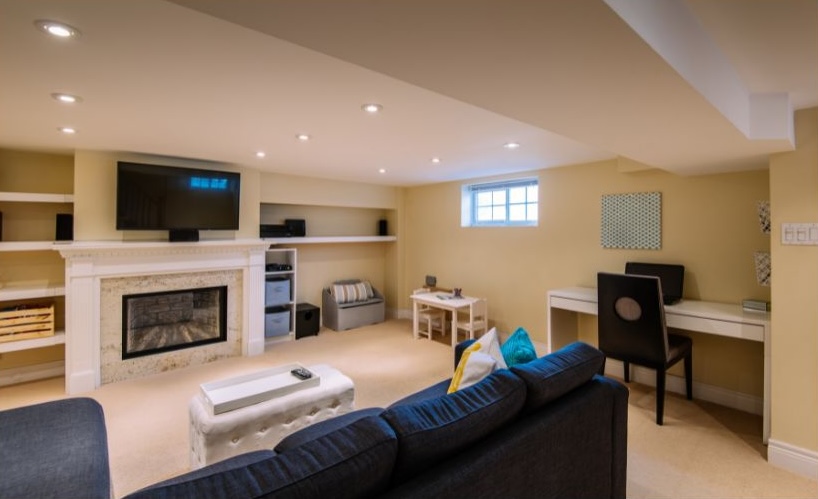
For the last decade, “open concept” was the golden rule. But in 2026, Utahns are realizing that one giant 1,200 sq. ft. room is a nightmare for acoustics. Our basements are naturally echo chambers; when you combine a home theater with a gym and a kids’ play area in one open space, no one wins. The “noise bleed” from a treadmill or a Disney movie makes the “great room” unusable for anyone else.
In Utah County and Salt Lake, we’re seeing a massive trend toward “Defined Zones.” This isn’t a return to the dark, cramped rooms of the 1970s. Instead, it’s about using glass partitions, double-stud walls, and soundproofing to create purposeful “bubbles” within the floor plan. In a state where families are larger and work-from-home is the norm, privacy has become the new luxury.
The “Silent ROI” of Walls in 2026
In the 2026 real estate market, a “bedroom” on paper adds significantly more appraised value than an “open flex space.” To count as a bedroom in Utah, you need a closet and a code-compliant egress window. By dividing your basement, you aren’t just adding walls—you’re adding line items to your home’s valuation that can net an extra $15k–$25k per room at resale.
Layout Battle: Open-Concept vs. Divided Rooms
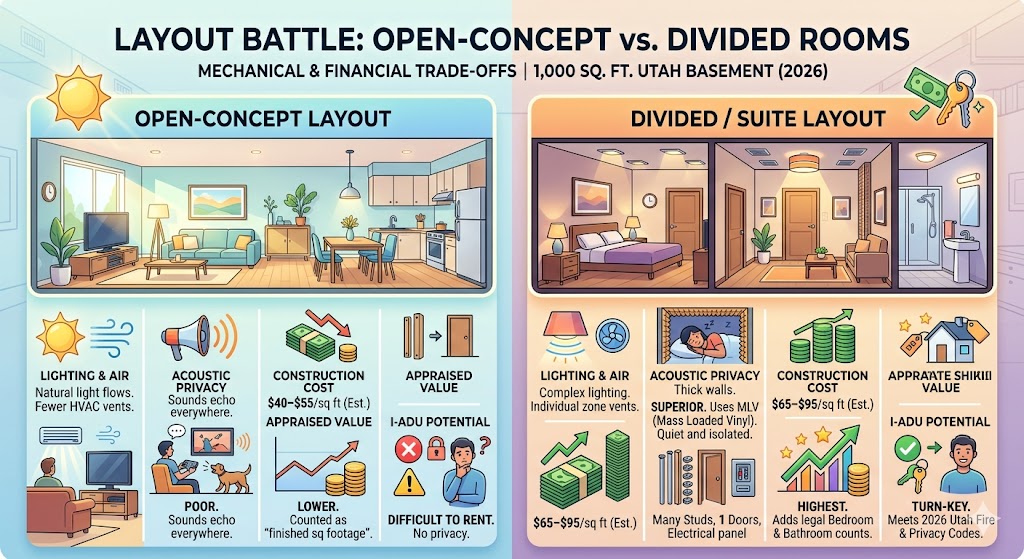
Before you finalize your blueprints, you need to understand the mechanical and financial trade-offs. Here is how the two philosophies stack up for a typical 1,000 sq. ft. Utah basement in 2026:
| Feature | Open-Concept Layout | Divided / Suite Layout |
|---|---|---|
| Lighting & Air | Natural light flows everywhere; fewer HVAC vents needed. | Requires complex lighting layers and individual zone vents for air. |
| Acoustic Privacy | Poor. Every footstep and TV sound echoes across the entire floor. | Superior. Use of MLV (Mass Loaded Vinyl) can isolate rooms entirely. |
| Construction Cost | Lower ($40–$55/sq ft). Minimal framing and fewer doors/trim. | Higher ($65–$95/sq ft). Added drywall, doors, and electrical circuits. |
| Appraised Value | Lower. Appraised as “finished sq footage” only. | Highest. Adds legal bedroom and bathroom counts to the listing. |
| I-ADU Potential | Difficult to rent. No privacy for tenants or owners. | Turn-key. Meets 2026 Utah House Hacking fire/privacy codes. |
Blunt Truth: If you plan on selling in the next 5 years, divide the space. Utah buyers in 2026 are looking for 4+ bedroom homes to accommodate large families and home offices. An open basement is a “DIY” vibe that suggests the project wasn’t fully finished.
The Utah Multi-Gen Factor: Why Divided Rooms are the “Equity King”
In 2026, Utah has solidified its spot as one of the leaders for multigenerational living in the U.S. It’s no longer just a trend; it’s a structural shift in our housing market. Whether it’s adult children fighting 6% mortgage rates by moving back home or aging parents moving in to avoid the skyrocketing costs of assisted living in Salt Lake, a divided basement is the ultimate insurance policy. In 2026, Utah buyers aren’t just looking for “finished square footage”, they are hunting for “Independent Living Zones.”
A divided layout allows for what local contractors call “The Fortress Effect.” By carving out a dedicated bedroom with a private en-suite bathroom and a small kitchenette, you create a self-contained wing that functions independently from the main floor. This is exactly why “Divided Room” requests have spiked by over 40% in high-growth tech hubs like Lehi, Riverton, and Salt Lake City this year.
The “Independent Suite” Advantage
In the 2026 Utah market, a basement that mirrors the quality of the main floor is a massive differentiator. To achieve a true multi-gen suite, focus on these three pillars:
- Acoustic Separation: Using double-layer drywall and Rockwool insulation in the ceiling to ensure the “grandparents’ wing” doesn’t hear every footstep from the kitchen above.
- Egress Logic: Positioning the bedroom near a code-compliant egress window to maximize natural light and ensure safety.
- HVAC Autonomy: Installing a dedicated mini-split or zoned thermostat so the basement occupant can keep it at 72°F without roasting everyone on the second floor.
From a financial perspective, the data from early 2026 is clear: homes with “Mother-in-Law” suites or divided guest wings are spending 30% less time on the market in Salt Lake County compared to those with open-concept basements. Buyers are willing to pay a premium for a home that can “house hack”using that divided space to offset a mortgage or care for family without sacrificing their own privacy.
Strategic Insight: If you’re building in Silicon Slopes, design the suite to double as a high-end executive home office. The same soundproofing and electrical runs required for a quiet bedroom make for the most productive workspace in the house protecting your ROI regardless of how you use the room.
Realistic 2026 Cost Comparison: 1,000 Sq. Ft. Project
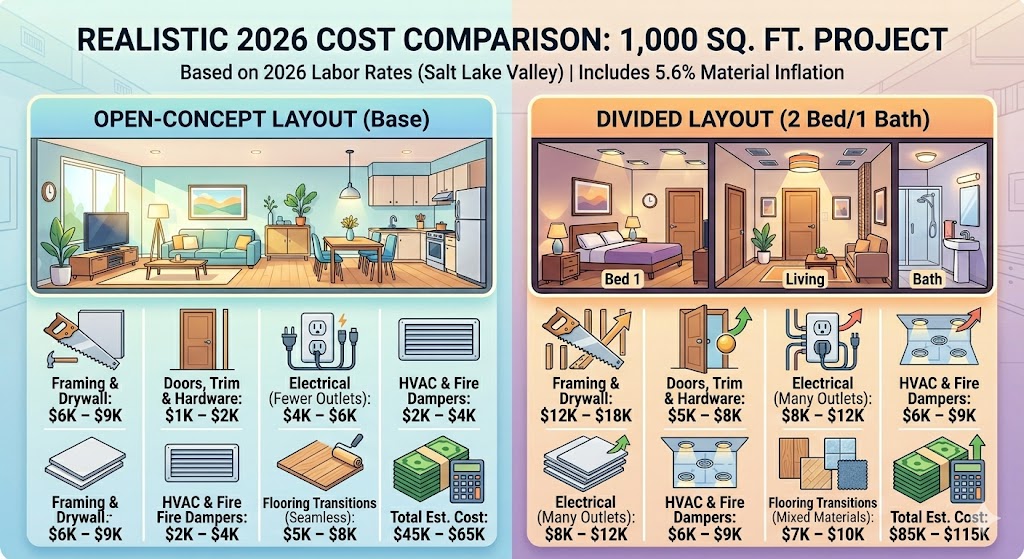
Let’s look at the numbers. These are based on 2026 labor rates in the Salt Lake Valley, including the 5.6% material inflation adjustment from earlier this year.
| Project Line Item | Open-Concept | Divided (2 Bed/1 Bath) |
|---|---|---|
| Framing & Drywall | $6K – $9K | $12K – $18K |
| Doors, Trim & Hardware | $1K – $2K | $5K – $8K |
| Electrical (Per Outlets/Cores) | $4K – $6K | $8K – $12K |
| HVAC & Fire Dampers | $2K – $4K | $6K – $9K |
| Flooring Transitions | $5K – $8K (Seamless) | $7K – $10K (Mixed materials) |
| Total Est. Cost | $45K – $65K | $85K – $115K |
Curious about how these layouts affect your home’s specific value?
When Open-Concept Makes Sense (The Rare Exceptions)
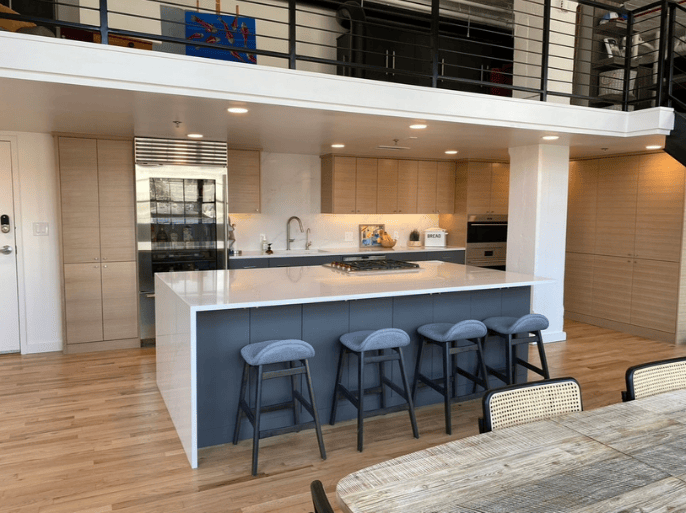
Despite the push for rooms, an open layout still has a place in 2026. If your basement has low ceilings (under 8 feet), walls will make the space feel like a subterranean bunker. An open concept keeps sightlines long and makes a small 600 sq. ft. basement feel twice as large.
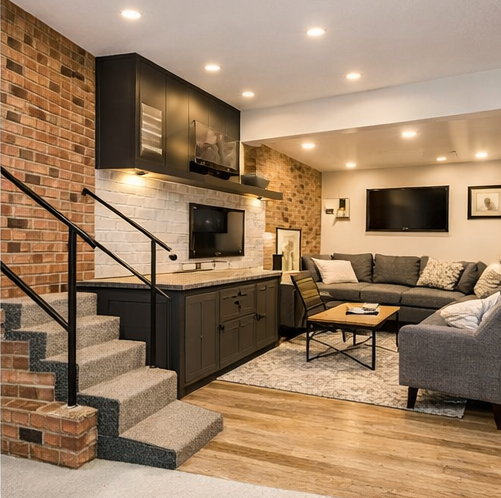
It’s also the better choice for dedicated Recreation Zones. If the primary goal is a pool table, a large sectional for Jazz games, and a massive wet bar, walls only get in the way of the party. In these cases, we use “Psychological Walls”changes in ceiling height (soffits), different flooring (LVP to carpet), or strategic lighting to define the space without blocking the view.
Pro Tip: If you go open-concept, invest in acoustic clouds or felt wall panels. Utah’s concrete foundations reflect sound waves like crazy. Without some form of sound absorption, even a quiet conversation in an open basement can sound like a shouting match.
Final Verdict: Which Layout Is Right for You?
Choosing between Open-Concept and Divided Rooms comes down to your 5-year plan. If you are a young family in Lehi or Draper looking to maximize property value and potentially house-hack, a Divided Suite is the winner every time. It offers the privacy, acoustic isolation, and “bedroom count” that the 2026 market demands.
However, if you have a massive walkout basement and your goal is pure entertainment like sports, movies, and parties, the Open-Concept layout remains the king of the “wow” factor. Just remember to invest in high-end soundproofing to keep the noise from taking over your entire house.

Frequently Asked Questions – Utah Basement Layouts 2026
Will an open-concept basement hurt my resale value in Salt Lake County?
It won’t “hurt” it, but it limits your buyer pool. In 2026, the most sought-after listings are those that can accommodate a home office or a guest suite. An open basement is often viewed as “unfinished potential” rather than “finished luxury.” Adding at least one legal bedroom typically provides a 150% ROI on the cost of the framing and drywall.
How do I soundproof a divided basement room?
In Utah, the biggest mistake is only soundproofing the walls. You must address the ceiling joists. In 2026, we recommend a combination of Rockwool insulation, Resilient Channels (to decouple the drywall from the wood frame), and two layers of 5/8″ Type X drywall. This ensures your “Quiet Office” stays quiet even when kids are running on the hardwood floors upstairs.
Does Utah code allow for “floating walls” in a divided layout?
Yes, and they are mandatory in many parts of the Wasatch Front. Because of our expansive clay soil, your basement floor can “heave” (move up and down). If you bolt a wall directly to the floor and the ceiling, a floor shift could crush your drywall or damage your upper-level floor joists. “Floating” the wall involves leaving a 1.5-inch gap at the bottom to allow for soil movement.
Can I turn an open basement into an I-ADU later?
It’s much more expensive to retrofit. To meet 2026 I-ADU standards, you need fire-rated drywall, separate HVAC controls, and specific egress. If you think you might rent the space in the future, it is significantly cheaper to “rough-in” the walls and plumbing today than to tear out your open-plan finishes in three years.
What is the single biggest mistake in basement layout design?
Ignoring the Mechanical Room. Many homeowners try to hide the furnace and water heater in a tiny, cramped closet to save room for an open layout. In 2026, high-efficiency systems require specific airflow and clearance. If you don’t plan your layout (divided or open) around your HVAC system, you’ll end up with a basement that is either freezing or dangerously poorly ventilated.
Ready to see which layout fits your Utah basement footprint?
ProWorx Construction • Salt Lake County • Utah County • Davis County • Summit County