
If you’re thinking about finishing your basement in Utah, you’ve probably already Googled “ccost per square foot”… and walked away more confused than when you started. In early 2026, the data is all over the place.
“Why does one quote say $50K… and another say $130K for the same 1,000 sq ft basement in Salt Lake County?”
That gap isn’t random. It’s exactly where most Utah homeowners get burned. Scroll through r/Utah or r/HomeImprovement and you’ll see the same story repeated: a family budgets $60K for a Draper or Lehi basement finish, the framing starts smoothly, then halfway through they’re staring at a $95K+ invoice with no easy way out. In 2026, labor shortages, surprise HVAC upgrades, and mandatory radon mitigation are the usual culprits behind these budget blowouts.
The reality? Basement finishing in Utah isn’t a single number, it’s a complex stack of 50+ variables. Along the Wasatch Front, factors like expansive clay soil (which creates hydrostatic pressure nightmares), ceiling heights, and existing plumbing rough-ins move the needle fast. Even your electrical panel’s capacity can swing a budget by $5,000 before you’ve even picked out flooring.
With housing density skyrocketing and Utah’s updated 2026 Internal ADU (I-ADU) laws, poor planning is the fastest way to destroy your ROI. If you don’t control these technical decisions upfront, your budget controls you — and you end up paying the “contractor tax” for decisions made on the fly.
In this 2026 breakdown, we’re stripping away the “sugar-coated” estimates to show you the real numbers for finishing a basement in Utah right now.
Step 1: Start With Your Real Goal (Not Pinterest or TikTok)
Most homeowners make the same critical mistake: they start with inspiration photos of luxury theater rooms or Instagram-worthy wet bars instead of defining a clear strategy. But in Utah’s 2026 market, your entire budget depends on what you’re actually trying to achieve and how you plan to use the space for the next 5–10 years.
The 3 Real Basement Goals in Utah Right Now
- Extra Living Space: Bedrooms, family room, playroom or home office. This is the lowest-cost option and the most common for growing families in Lehi, Draper, or Sandy.
- Lifestyle Upgrade: Dedicated theater, gym, bar, or high-end office. Mid-range pricing but huge daily enjoyment factor — especially with Utah’s long winters.
- Income Generator (Legal ADU): Full apartment with kitchen, bath, and separate entrance. Highest upfront cost but the best ROI thanks to Utah’s updated ADU laws and strong rental demand in Salt Lake and Utah Counties.
On Reddit (r/Utah and r/homeowners), the #1 regret in 2025–2026 threads is identical: “We tried to do everything in one go and the budget exploded.” One homeowner in South Jordan posted that they started with a simple playroom plan and ended up adding a full kitchen “just because” pushing their project from $68K to $112K with multiple change orders.
Blunt Truth from Utah Contractors: If your goal isn’t crystal clear before the first bid, your contractor will automatically price for the highest-complexity scenario (full electrical + plumbing + ADU code compliance). That single decision alone can add $30K–$40K.
Step 2: Understand the Real Cost Per Square Foot in Utah (2026 Data)
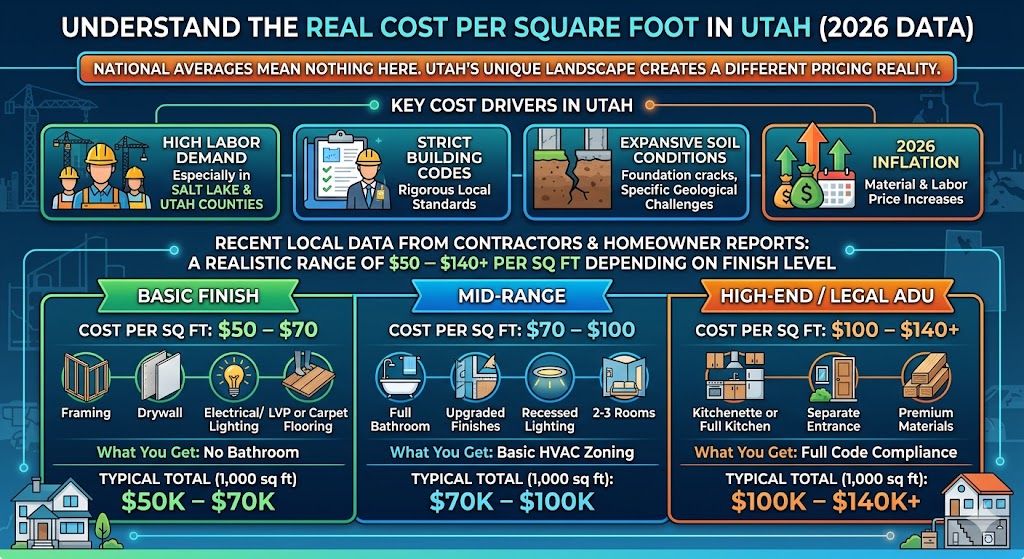
National averages mean nothing here. Utah’s high labor demand (especially in Salt Lake and Utah Counties), strict building codes, expansive soil conditions, and 2026 material/labor inflation create a completely different pricing landscape. Recent local data from contractors and homeowner reports show a realistic range of $50–$140+ per square foot depending on finish level.
| Finish Level | Cost Per Sq Ft (Utah 2026) | What You Get | Typical Total (1,000 sq ft) |
|---|---|---|---|
| Basic Finish | $50 – $70 | Framing, drywall, basic electrical/lighting, LVP or carpet flooring, no bathroom | $50K – $70K |
| Mid-Range | $70 – $100 | Full bathroom, upgraded finishes, recessed lighting, 2–3 rooms, basic HVAC zoning | $70K – $100K |
| High-End / Legal ADU | $100 – $140+ | Kitchenette or full kitchen, separate entrance, premium materials, full code compliance | $100K – $140K+ |
Example breakdown for real Utah homes: A 1,200 sq ft basement in Draper (mid-range with bathroom) typically lands around $92K–$118K in early 2026. The same size in a flat lot in West Jordan with no existing plumbing rough-ins can easily hit the high end because of extra trenching and slab cutting.
Key 2026 price drivers in Utah: labor shortages (contractors are booking 3–6 months out), higher insulation requirements for energy codes, and the push for smart-home ready electrical.
Step 3: The Hidden Costs That Wreck Utah Budgets
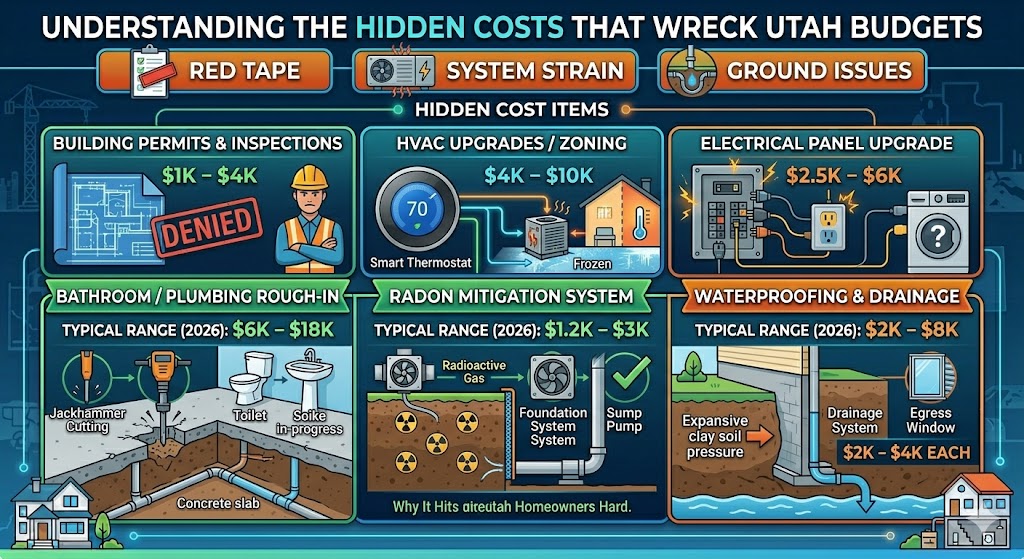
This is where 80% of Reddit horror stories begin. Rough quotes often ignore these entirely, and by the time you discover them, you’re already committed.
| Hidden Cost Item | Typical Range (2026) | Why It Hits Utah Homeowners Hard |
|---|---|---|
| Building Permits & Inspections | $1K – $4K | Required for any electrical, plumbing, or habitable space changes — Salt Lake & Utah County are strict |
| HVAC Upgrades / Zoning | $4K – $10K | Most existing systems can’t handle the extra load; zoning prevents “basement freeze” in winter |
| Electrical Panel Upgrade | $2.5K – $6K | Old 100–200 amp panels max out fast with new lights, outlets, and appliances |
| Bathroom / Plumbing Rough-In | $6K – $18K | Cutting into concrete slab is labor-intensive and messy |
| Radon Mitigation System | $1.2K – $3K | Utah’s geology makes radon testing mandatory in many areas |
| Waterproofing & Drainage | $2K – $8K | Expansive clay soil + snowmelt = hydrostatic pressure nightmares |
| Egress Windows (for bedrooms) | $2K – $4K each | 2026 IRC code requires proper size and wells for legal bedrooms |
Pro Tip from Real Utah Homeowners: Always add a 15–20% contingency buffer in 2026. Labor and material prices are still fluctuating, and one unexpected soil issue or code change can eat that buffer fast. Reddit threads are full of people who skipped this step and regretted it.
Ready for a realistic, no-surprise quote for your Utah basement?
Step 4: Build Your Budget Backwards (The Smart Way)
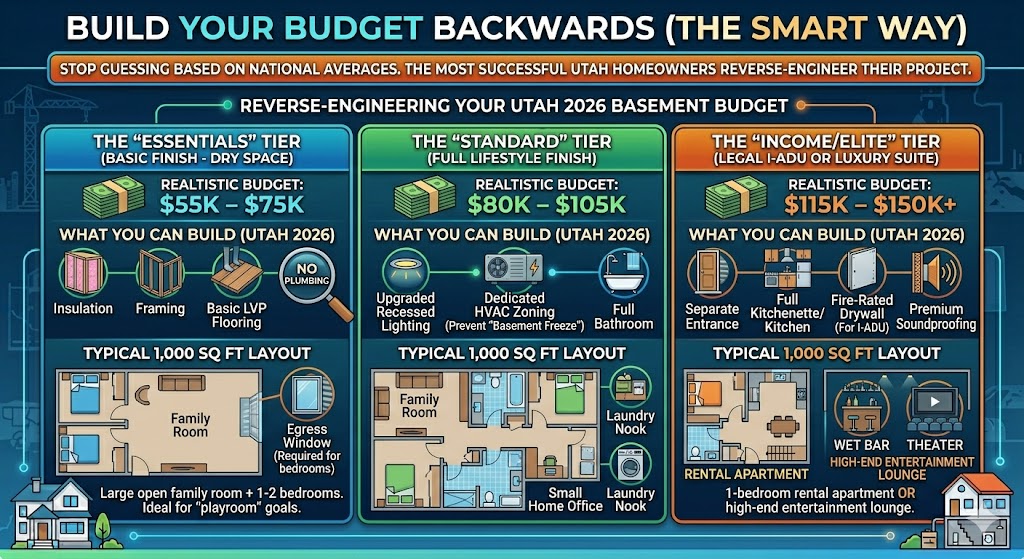
Stop guessing based on national averages. In 2026, the most successful Utah homeowners reverse-engineer their project. Start with your “all-in” number and see what that actually buys you along the Wasatch Front.
| Your Realistic Budget | What You Can Build (Utah 2026) | Typical 1,000 Sq Ft Layout |
|---|---|---|
| $55K – $75K The “Essentials” Tier |
Basic Finish (Dry Space). Focuses on insulation, framing, and basic LVP. No plumbing or bathroom additions. | Large open family room + 1-2 bedrooms with required egress windows. Ideal for “playroom” goals. |
| $80K – $105K The “Standard” Tier |
Full Lifestyle Finish. Includes a 3/4 or full bathroom, upgraded recessed lighting, and dedicated HVAC zoning. | Family room, 2 bedrooms, full bathroom, and a small home office or laundry nook. |
| $115K – $150K+ The “Income/Elite” Tier |
Legal I-ADU or Luxury Suite. Separate entrance, full kitchenette/kitchen, fire-rated drywall, and premium soundproofing. | 1-bedroom rental apartment or high-end entertainment lounge with wet bar and theater. |
Pro Tip: Print this table and bring it to your initial consultation. If a contractor tells you they can build a full legal ADU for $60K in 2026, they are likely cutting corners on permits, fire-blocking, or waterproofing—all of which will cost you double in repairs or fines later.
Step 5: Decide Where to Spend vs. Save (Smart Trade-Offs)
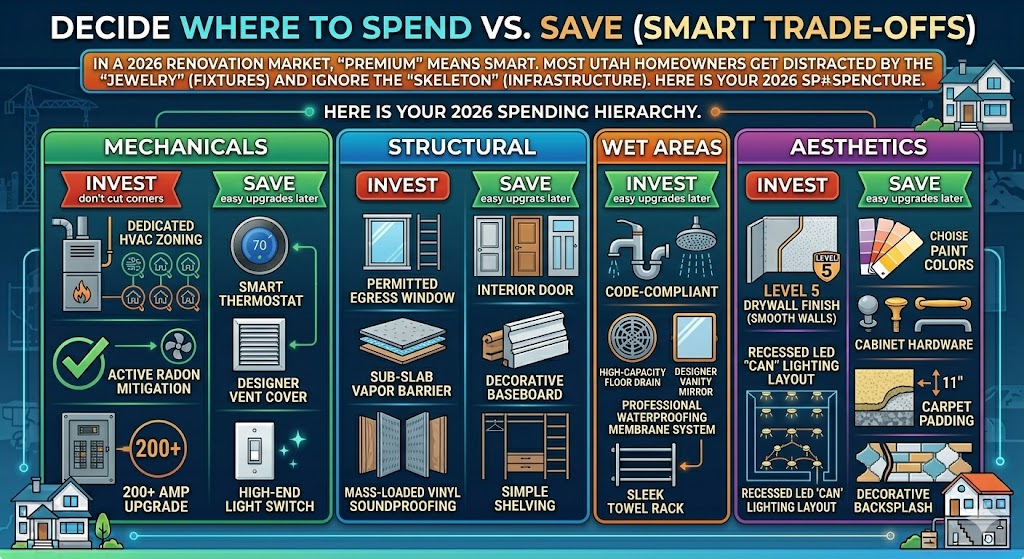
In a 2026 renovation market, “premium” doesn’t always mean “expensive”—it means smart. Most Utah homeowners get distracted by the “jewelry” (the fixtures) and ignore the “skeleton” (the infrastructure). Here is your 2026 spending hierarchy:
| Category | The “Invest” List (Don’t Cut Corners) | The “Save” List (Easy Upgrades Later) |
|---|---|---|
| Mechanicals | Dedicated HVAC zoning, active radon mitigation, and 200+ amp electrical panel upgrades. | Smart thermostats, designer vent covers, and high-end light switches. |
| Structural | Permitted egress windows, sub-slab vapor barriers, and mass-loaded vinyl soundproofing. | Interior door styles, decorative baseboards, and closet shelving systems. |
| Wet Areas | Code-compliant plumbing runs, high-capacity floor drains, and professional waterproofing. | Faucets, showerheads, vanity mirrors, and towel racks. |
| Aesthetics | Level 5 drywall finish (smooth walls) and recessed LED “can” lighting layout. | Paint colors, cabinet hardware, carpet padding, and backsplash tile. |
Blunt Truth: You can swap a $100 faucet for a $600 designer one in 20 minutes three years from now. You cannot easily add a window or fix a freezing room once the walls are closed. Spend on the “boring” stuff that keeps the room comfortable and legal; save the “jewelry” for a future bonus.
Step 6: How to Get Accurate Quotes & Avoid Surprises
Once your plan is clear, it’s time to talk to contractors. In Utah’s 2026 market, the “per square foot” quote is a trap. You need a partner who understands the local geology and the strict 2026 code updates. Here is exactly how to vet your bids:
- Insist on a line-item breakdown: Never accept a lump-sum price. You need to see the specific cost for framing, electrical, and plumbing rough-ins tied to your layout.
- Ask for local 2026 references: Request contacts for projects completed in the same city (e.g., Lehi, Draper, or Sandy) within the last 12 months. This proves they can navigate your specific city’s inspection queue.
- Demand a Written Contingency Plan: In Utah, “surprises” usually mean expansive clay soil or outdated electrical panels. A pro will have a written protocol for how these are billed if discovered.
- The “Permit Test”: If a contractor suggests skipping permits to “save you $3,000,” show them the door. In 2026, unpermitted basements are a liability that can stall a home sale indefinitely.
2026 Utah Market Trends Affecting Your Budget
The Wasatch Front is currently seeing a “flight to quality.” While material prices for lumber have stabilized, the cost for high-efficiency insulation and smart electrical components remains elevated.
Additionally, with Utah’s aggressive I-ADU incentives, more homeowners are opting for high-end “rental-ready” finishes. This demand has kept skilled labor tight. The payoff? Data from early 2026 shows that homes in Salt Lake and Utah Counties with professionally finished, permit-backed basements are selling 5–10% faster than those with unfinished or “handyman-special” spaces.

Final Thoughts: Control the Plan, Control the Cost
A realistic basement finishing budget in Utah isn’t about guessing—it’s about understanding every trade-off before the first nail is driven.
The homeowners who succeed in 2026 aren’t the ones who spend the least. They’re the ones who plan the smartest, define their goals early, build in a 20% contingency, and choose a contractor who respects both their vision and the local building codes.
Ready for a realistic, no-surprise quote for your Utah basement?
Frequently Asked Questions About Utah Basement Budgets
Why do Utah basement quotes vary so much in 2026?
The gap between a $50K and $130K quote usually comes down to “Hidden Infrastructure.” In 2026, a low-ball quote often ignores mandatory radon mitigation, HVAC zoning, or electrical panel upgrades. Along the Wasatch Front, if a bid doesn’t account for expansive clay soil or moisture barriers, that $50K “deal” will inevitably balloon with change orders once the contractor opens your walls.
What is the most accurate way to estimate my basement budget?
Stop using “national averages.” The smartest way is to build your budget backwards. Determine your “all-in” number—whether it’s $60K for extra bedrooms or $120K for a legal I-ADU—and let the goal dictate the square footage. In the 2026 Utah market, trying to “guess” a per-square-foot price without a clear theme is how 80% of homeowners end up over budget.
How much should I actually set aside for a “contingency fund”?
In 2026, we strictly recommend a 15–20% buffer. Between fluctuating material costs and common Wasatch Front surprises (like discovering your plumbing rough-ins aren’t where the builder said they were), this buffer ensures your project doesn’t stall. On Reddit (r/Utah), the biggest regret homeowners share is not having this “emergency” cash ready when a code inspector requires a surprise upgrade.
Does a finished basement really increase my home’s value in Utah?
Yes, but only if it’s permitted. Data from early 2026 shows that homes in Salt Lake and Utah Counties with professionally finished, permit-backed basements sell 5–10% faster. However, if you skip permits to “save” $3K now, you’ll likely lose $20K+ in equity because appraisers cannot count unpermitted square footage toward your home’s total value.
What is the “Basement Freeze” and why is it a budget killer?
This happens when homeowners “save money” by not adding a dedicated HVAC zone. Because heat rises, your main-floor furnace shuts off while the basement stays 10 degrees colder. Fixing this after the drywall is up costs $10K+; doing it during the initial build costs roughly $4K–$7K. Investing in zoning is the single best way to protect your lifestyle ROI.
Should I spend more to make my basement a “Legal I-ADU”?
If you want the highest ROI, yes. While a Legal I-ADU (Internal Accessory Dwelling Unit) costs $25K–$40K more upfront due to fire-rated separation and separate entrances, it transforms a “man cave” into a cash-flowing asset. With Utah’s 2026 rental demand, an ADU in areas like Lehi or Draper can pay for your entire basement renovation within 5–7 years.
Ready for a realistic, no-surprise quote based on your actual layout and goals?
Published April 2026 • ProWorx Construction • Serving Salt Lake County, Utah County & Beyond