
Overview
A Utah basement finishing quote is only as useful as what it actually includes. Budget quotes routinely leave out permits, subfloor systems, electrical panel upgrades, egress window installations, HVAC work, and material selections that will exceed their placeholder allowances, all of which show up later as change orders after the homeowner has already signed and construction has begun. This guide covers every line item a complete Utah basement quote should contain, the specific items most commonly left out of low quotes, how material allowances generate change orders, and the questions to ask before you sign anything.
Table of Contents
- What Should Every Utah Basement Finishing Quote Include as a Line Item?
- What Are the Most Common Items Missing From Low Utah Basement Quotes?
- What Is a Material Allowance and Why Does It Generate Change Orders?
- How Do You Compare Two Utah Basement Quotes Side by Side?
- What Contract Terms Should Accompany Any Utah Basement Quote?
- What Questions Should You Ask Before Signing a Utah Basement Quote?
- Frequently Asked Questions
The call usually comes in around week six of a basement project. The homeowner was expecting to spend $62,000. The contractor has just presented a change order for $11,000 covering the electrical panel upgrade, the bathroom fixture package beyond the allowance, and the HVAC duct extension that was not included in the original scope. None of these items came out of nowhere. All of them were predictable from the first walkthrough. The problem was they were not in the quote.
We finish basements across Utah County, Salt Lake County, Davis County, and Summit County. There is a significant difference between a complete quote and a low quote, and most homeowners only discover it after they have signed. Here is how to tell the difference before that happens.
What Should Every Utah Basement Finishing Quote Include as a Line Item?
A complete Utah basement finishing quote is not a single number. It is a line-item document that accounts for every trade, every material category, and every infrastructure requirement specific to your home. If a quote does not address these items, either they are not included or they will appear as change orders later.
| Line Item | What It Should Specify | Red Flag if Missing |
|---|---|---|
| Permit fees | Building permit plus separate trade permits for electrical, plumbing, and mechanical. Actual fee amounts, not an allowance. | Very high. Permits are a legal requirement and their cost is knowable. A vague allowance here signals the contractor has not confirmed actual city fees. |
| Framing | Linear feet of exterior wall framing, interior partition walls, and all soffits and chases around ductwork, beams, and mechanical equipment. | High. Soffits and chases around mechanical equipment are commonly left out and added as change orders during framing. |
| Electrical rough-in and finish | Number of circuits, outlet count, AFCI protection, GFCI locations, panel capacity assessment, dedicated circuits for bathroom and any appliances. | Very high. A quote that does not address the electrical panel’s capacity has not confirmed whether the existing panel can handle the new load. |
| Electrical panel upgrade (if needed) | If the home has 100-amp service, this should be a confirmed line item or a stated exclusion. Cost: $2,000 to $4,500. | Very high for 1990s homes or older. Missing this entirely means it will appear as a change order during rough-in. |
| Plumbing rough-in and finish | Should specify whether it covers rough-in only, finish only, or both. Includes fixture count, drain line work, venting method. | High. Rough-in and finish are often quoted separately and homeowners assume both are included when only rough-in was priced. |
| HVAC extension or zoning | How the basement will be heated and cooled, whether existing ductwork is being extended or a separate system is being added, and what that costs. | Very high. HVAC for the basement is frequently either vague or absent from budget quotes and becomes a significant change order. |
| Insulation | Type, R-value, and coverage area on foundation walls and rim joists. Should meet or exceed current Utah 2021 IRC requirements for climate zone 5B. | Moderate. Some budget quotes include insulation but at below-code R-values to keep the number low. Verify the specified R-value. |
| Subfloor or moisture management system | Whether the quote includes a dimpled membrane, mechanical subfloor panels, or direct flooring over concrete. Should reflect the soil and moisture conditions of your specific location. | High. Budget quotes often default to direct-to-concrete flooring installation without a subfloor system. For valley floor clay soil homes this is a flooring failure waiting to happen. |
| Egress window installation | If any bedroom is planned, the complete egress window scope: foundation cut, window, well, drainage, and interior repair. Not just the window cost. | Very high. Foundation cutting, window well drainage, and interior drywall repair after the window is in are frequently underquoted or absent. |
| Drywall, texture, and paint | Square footage of drywall, texture type, number of paint coats, whether soffits and beam pockets are included, and whether trim paint is separate. | Moderate. Soffits, beams, and trim are commonly excluded from flat drywall quotes and added separately. |
| Flooring | Material type and grade, or a per-square-foot allowance clearly stated as an allowance. Allowances should reflect real mid-range material costs, not entry-level pricing. | High. Low allowances, often $3 per square foot when real LVP runs $4 to $7, are a common source of change orders when the homeowner selects actual materials. |
| Bathroom fixtures and tile | Whether the allowance covers toilet, vanity, mirror, shower pan or tile, and fixtures. Should be a realistic allowance for the finish level described in the contract. | Very high. Bathroom fixture allowances are the single most common source of change orders in Utah basement projects. |
| Cleanup and haul-away | Whether the contractor handles dumpster and disposal throughout the project or whether that is the homeowner’s responsibility. | Low to moderate. Often an add-on that was not in the original quote. |
| Smoke and CO detector installation | Hardwired interconnected smoke and CO detectors required by code in any basement bedroom. Should be a specified line item, not a verbal assumption. | Moderate. Often missing from budget quotes and then added as an extra when the inspector flags it. |
What Are the Most Common Items Missing From Low Utah Basement Quotes?
The items below are the most reliable predictors of change orders in Utah basement projects. Their presence or absence in a quote tells you more about the contractor’s approach than almost anything else.
The five most common missing items:
- Electrical panel upgrade. A contractor who quotes a basement finish without checking the panel capacity and confirming whether the existing service can handle the new load has not done a complete assessment. For any home with 100-amp service, this is almost certainly a required cost of $2,000 to $4,500 that the budget quote simply excludes.
- Complete egress window scope. Many quotes list “egress window” as a single line item with a partial cost. The complete scope is the foundation wall cut, the window unit, the window well, the gravel drainage bed, the drain tile connection, and the interior drywall repair after installation. Any of these missing from the egress line item will appear later.
- HVAC for the basement space. Budget quotes often state that the homeowner is responsible for HVAC, or include a vague note about tying into existing ductwork. The actual cost of properly extending the HVAC system to serve a finished basement, or installing a mini-split alternative, is a meaningful number that belongs on the quote, not in a post-framing conversation.
- Subfloor system. A flat square footage rate applied to a basement finish often assumes direct flooring installation over concrete. On Utah valley floor clay soil, this leads to flooring failure. The subfloor system, whether a dimpled membrane or mechanical panels, needs to be a specified line item or a stated exclusion so the homeowner knows what they are getting.
- Permits as actuals, not allowances. Every Utah city basement finish permit has a known fee structure. A vague permit allowance on a quote signals the contractor has not confirmed actual fees, which means the allowance may not cover the real cost.
A homeowner in Millcreek received three quotes ranging from $54,000 to $81,000 for the same 1,100 square foot basement. The lowest quote had no electrical panel line item, a $2,500 egress window allowance that did not include the foundation cut, no HVAC scope, and a $3 per square foot flooring allowance. The highest quote included a $3,800 panel upgrade, a complete $5,200 egress window scope, a confirmed HVAC extension, and a $5.50 per square foot flooring allowance based on the homeowner’s stated finish preference. When all the missing items from the low quote were priced separately, it came out $12,000 higher than the high quote, not $27,000 lower. The homeowner chose the high quote. They told us later it was the most obvious decision they made in the entire project.
What Is a Material Allowance and Why Does It Generate Change Orders?
A material allowance is a placeholder dollar amount for a category of material that the homeowner has not yet selected. Allowances are not inherently bad. They are a legitimate quoting tool for items that depend on the homeowner’s final selection. The problem is when allowances are set below realistic market costs so that the quote looks more competitive than it is.
| Material Category | Common Low Allowance | Realistic 2026 Mid-Range Cost | Change Order Risk |
|---|---|---|---|
| LVP flooring (materials only) | $2.50 to $3.00 per sq ft | $4.00 to $7.00 per sq ft | On 1,000 sq ft: $1,000 to $4,000 additional |
| Bathroom fixtures (toilet, vanity, mirror) | $800 to $1,200 allowance | $1,500 to $3,500 for mid-range selections | $700 to $2,300 additional |
| Shower tile and installation | $1,500 to $2,000 allowance | $2,500 to $5,500 for mid-range tile and labour | $1,000 to $3,500 additional |
| Light fixtures | $500 allowance for whole basement | $1,000 to $2,500 for mid-range selections | $500 to $2,000 additional |
| Doors and hardware | $200 to $300 per door allowance | $350 to $600 per door installed | $150 to $300 per door additional |
How to handle allowances correctly:
- Ask your contractor what the allowance covers specifically and what happens if your selections exceed it
- Request that allowances be set at realistic mid-range costs, not entry-level pricing, so the quote reflects what you will actually spend
- For flooring and bathroom tile specifically, visit a showroom and price your actual preferred selections before signing. The difference between the allowance and your actual preference is your real change order risk in those categories.
- Understand that the change order process for exceeding an allowance is legitimate and expected. The problem is not allowances themselves. It is allowances that are deliberately set too low to make the quote look competitive.
How Do You Compare Two Utah Basement Quotes Side by Side?
Comparing total numbers from two quotes tells you almost nothing because the totals reflect different scopes. The only meaningful comparison is line by line. For every item in one quote, confirm whether it is in the other quote at the same specification.
Side by side comparison checklist:
- Are permits included in both, and as actual confirmed amounts or as allowances?
- Does both quotes address the electrical panel and confirm whether an upgrade is or is not needed?
- Does both quotes include HVAC for the basement space, and at what specification?
- Does both quotes include a subfloor or moisture management system, or does either quote assume direct flooring over concrete?
- If a bedroom is planned, does both quotes include the complete egress window scope including foundation cut and interior repair?
- Are the flooring allowances set at the same per-square-foot rate?
- Are the bathroom fixture allowances at comparable levels?
- Does both quotes include cleanup and haul-away?
- What is each contractor’s change order process and what requires written approval?
As Pro-Worx’s quote comparison guide notes, a lower bid often lacks detail or excludes important components, and the final cost increases through change orders. The best quote is the one that most clearly defines the full scope and gives you the fewest surprises after you sign, not the one with the lowest initial number.
A homeowner in North Ogden brought us two quotes to review before signing with either contractor. One was $61,000 with a detailed 23-line item breakdown. The other was $47,000 with eight line items and several described as “as needed.” We went through both line by line. The $47,000 quote was missing the panel upgrade, had no HVAC scope, was using a $3 flooring allowance, and had a bathroom allowance of $900. When we priced the missing items at current 2026 costs, the $47,000 quote became $71,000. The $61,000 quote already included all of it. They signed with the $61,000 contractor. The project finished on time and on budget. They said the forty-five minutes they spent comparing the two quotes saved them from a very expensive lesson.
What Contract Terms Should Accompany Any Utah Basement Quote?
The quote is what gets built. The contract is what protects you while it is being built. These terms should appear in every Utah basement finishing contract regardless of the contractor.
Contract terms to verify before signing:
- Change order requirement. Any cost addition or scope change above a defined threshold requires written change order approval before the work proceeds. Verbal agreements on changes are not enforceable.
- Payment schedule tied to milestones. Payments should be tied to completed phases, not calendar dates. Permit approval, framing complete, rough-ins passed, drywall complete, and final walkthrough are standard milestones. Never pay a lump sum upfront.
- Contractor licence and insurance confirmation. The contract should confirm the contractor’s DOPL licence number and require that current general liability and workers compensation insurance certificates are on file.
- Completion date and delay provisions. A stated completion target and what happens to the project if it is materially delayed by contractor-caused issues.
- Lien waiver schedule. Signed lien waivers from the contractor and any subcontractors at each milestone payment. This is your protection against mechanic’s liens from subs the contractor has not paid.
- Warranty terms. What is covered, for how long, and what process the homeowner follows to make a warranty claim.
What Questions Should You Ask Before Signing a Utah Basement Quote?
| Question | What a Good Answer Looks Like | Red Flag Answer |
|---|---|---|
| Did you check the electrical panel? | Yes. Your panel is 200-amp with X circuits available, which is sufficient. OR: Your panel is 100-amp and an upgrade is included in line 4 at $3,200. | We will figure that out once we start. OR: There is an allowance for electrical. |
| What is the HVAC plan for the basement? | We are extending the existing trunk with two new registers, shown in line 7. OR: We recommend a mini-split for this size space, included in line 8 at $X. | You will need to handle HVAC separately. OR: We will tie into the existing system. |
| What does the flooring allowance cover? | The $5.50 per square foot allowance covers mid-range LVP including underlayment, installed. If your selection is higher, you pay the difference via change order. | It covers standard flooring. You can pick whatever you want. |
| What does the egress window line item include? | Foundation cut, window unit, window well, gravel drainage bed, and interior drywall repair. All in line 5 at $5,400 per window. | The window is included. The cutting is separate if needed. |
| What triggers a change order? | Any change in scope or material that affects cost requires a written change order signed by both parties before the work proceeds. No verbal approvals. | We will let you know if something comes up. |
| Can I verify your DOPL licence? | Yes, here is our licence number. You can verify it at secure.utah.gov/llv. | I do not have that handy. OR: We work under a general contractor’s licence. (Verify this claim.) |
Frequently Asked Questions
What should a Utah basement finishing quote include?
A complete Utah basement finishing quote should include permits as confirmed amounts, framing with soffits and chases, electrical rough-in and finish with panel capacity confirmed, plumbing rough-in and finish, HVAC scope, insulation at code R-values, subfloor or moisture management system, egress window complete scope if a bedroom is planned, drywall and texture, paint, flooring with a realistic allowance, bathroom fixtures with a realistic allowance, cleanup and haul-away, and smoke and CO detectors. Any item not addressed in the quote is either excluded or will become a change order.
Why do Utah basement quotes vary so much in price?
Because they do not all quote the same scope. A lower quote typically excludes or underestimates several items that a higher quote includes. Permit fees, electrical panel upgrades, egress window complete scope, HVAC for the basement, subfloor systems, and realistic material allowances are the most common differences. When missing items from a lower quote are priced separately, the total frequently exceeds the higher quote that included them from the start.
What is a material allowance in a basement finishing quote?
A material allowance is a placeholder amount for a category where the final material has not yet been selected. It is a legitimate quoting tool when set at a realistic cost. It becomes problematic when set below realistic market rates to make the quote look more competitive. Common low allowances are flooring at $2.50 to $3.00 per square foot when mid-range LVP runs $4 to $7, and bathroom fixtures at $800 to $1,200 when mid-range selections run $1,500 to $3,500. The difference between a low allowance and the homeowner’s actual selections is a guaranteed change order.
Should permits be included in a Utah basement finishing quote?
Yes, and they should be listed as confirmed amounts, not vague allowances. Building permits for a mid-range Utah basement finish typically run $400 to $900. Trade permits for electrical, plumbing, and mechanical are usually pulled separately and add additional cost. A contractor who lists a permit allowance without confirming actual city fees has not completed a full assessment of your project’s compliance costs.
What are the most common change orders in Utah basement projects?
The most common are electrical panel upgrades discovered at rough-in when the existing panel cannot handle the new load, bathroom fixture and tile selections that exceed the quoted allowance, egress window costs beyond what the initial quote included, HVAC work that was vaguely described or absent from the original scope, and framing complexity around mechanical equipment that was not fully visible during the walkthrough quote. All of these are predictable and should be addressed in a complete first quote.
How do I know if a Utah basement contractor is licensed?
Verify the contractor’s licence at secure.utah.gov/llv before signing anything. A licensed contractor in Utah holds a valid DOPL B100 or R100 classification. Verifying the licence also confirms the licence is active and in good standing, not just that the contractor claims to hold one. An unlicensed contractor removes your access to Utah’s Residence Lien Recovery Fund if something goes wrong.
Utah Basement Quote What Should Be Included • Basement Finishing Change Orders Utah • Utah Basement Contractor Quote Checklist
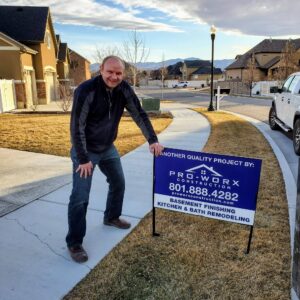
Bryant Bitner
Founder & Lead Project Manager, Pro-Worx Construction
Bryant has reviewed enough competitor quotes brought in by homeowners to know exactly which line items disappear when a contractor is trying to win on price rather than on scope. He quotes everything upfront, sets allowances at realistic mid-range costs, and does not present change orders for items that were predictable at the first walkthrough.
When he is not on job sites you will find him helping homeowners understand what a complete quote should look like before they sign anything with anyone.